Industry Portal
Related News
- Mobile Clinic & CT VehiclesModular Vehicle Interior Design: Common Layout Types and How to Match Them to Use CasesModular vehicle interior design explained: compare linear, galley, zoned, convertible, and cell-based layouts to match real use cases, improve workflow, safety, and long-term ROI.
- Mobile Capital & Fleet EconSpecialty Vehicle Fleet Solutions: What Impacts Total Cost of Ownership Most?Specialty vehicle fleet solutions impact TCO through downtime, maintenance, energy use, compliance, and resale value. Discover what drives costs most and make smarter fleet buying decisions.
- EV Urban Cold Chain TrucksElectric Cold Chain Transport vs Diesel Refrigerated Vans: Which Fits Urban Delivery?Electric cold chain transport vs diesel refrigerated vans: compare urban delivery costs, compliance, payload, and route fit to choose the smarter fleet strategy.
Mobile Command Centers: Power Redundancy Risks You Should Test




For technical evaluators responsible for uptime in mobile command centers, power redundancy is not a box to check—it is a failure path to model, simulate, and verify. From battery banks and inverter switchover logic to shore power, generators, and load prioritization, hidden single points of failure can compromise mission continuity. This article outlines the power redundancy risks you should test before field deployment.
In specialized ambulance fleets, field command trailers, mobile rescue hubs, and other vehicle-based operations covered by SMVS, the electrical architecture is often more complex than the floor plan suggests. A command center may appear to have 2 or 3 backup sources, yet still fail because one ATS setting, one DC bus fault, or one cooling issue disables the entire chain.
For technical evaluators, procurement teams, and system integrators, the objective is not simply to specify larger batteries or a higher kW generator. The objective is to verify whether mission-critical loads can survive transfer events, degraded charging, partial battery failure, and operator error over 8, 12, or 24 hours of real field use.
Why Power Redundancy Fails in Mobile Command Centers
Mobile command centers work under conditions that fixed facilities rarely face: vibration, thermal cycling, constrained installation space, intermittent shore power, and mixed AC/DC loads. That combination creates failure modes that may not appear during a bench test or a short factory acceptance run.
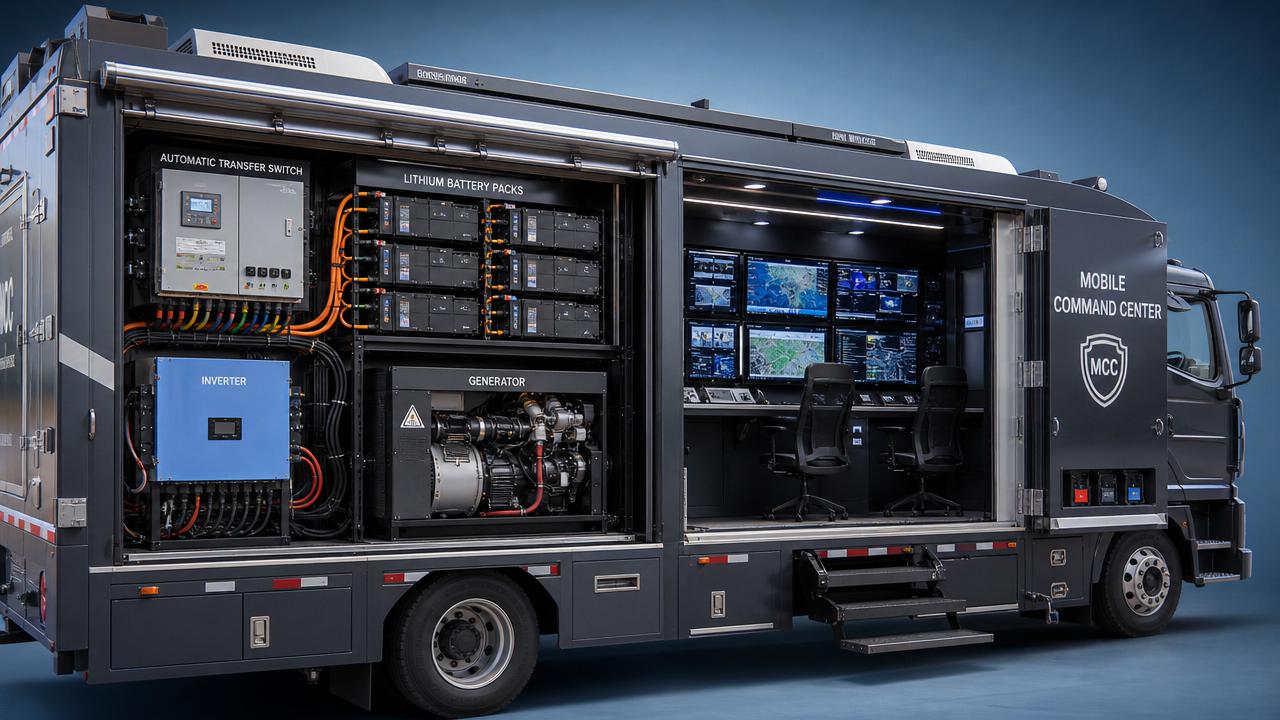
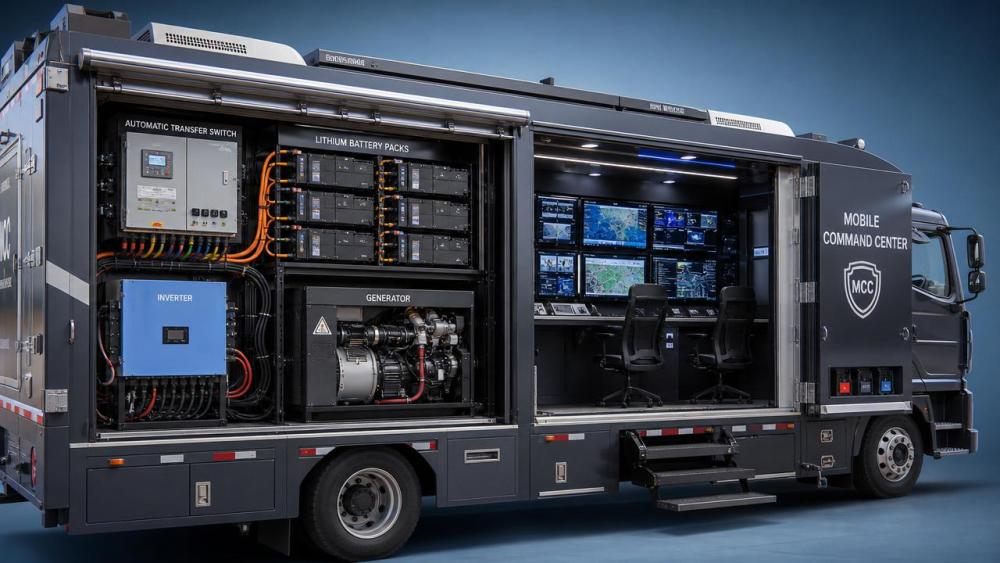
A typical vehicle may combine a 24V or 48V battery bank, inverter-charger, alternator charging, rooftop solar, shore input, and a diesel generator. On paper, that looks redundant. In practice, 4 sources can still collapse into 1 operational path if they depend on the same transfer relay, same control board, or same thermal management loop.
Common hidden single points of failure
The most common issue is shared dependency. Two power sources may feed the same distribution panel through a single automatic transfer switch. If that switch sticks, loses control power, or trips under inrush current, the entire command cabin can go dark in less than 1 second.
Another overlooked risk is battery management isolation. A LiFePO4 bank may have enough nominal capacity, such as 15kWh to 40kWh, but a BMS shutdown caused by overcurrent, low temperature charging, or cell imbalance can instantly remove the DC backbone. In that scenario, inverter redundancy means little if both inverters depend on the same battery disconnect logic.
Cooling is also a decisive factor. In hot-weather deployments above 35°C, inverter derating, generator enclosure heat soak, and battery compartment temperature rise can reduce usable output by 10% to 30%. A system that passes at 22°C in a workshop may fail after 3 hours on a paved staging site in summer.
Failure modes evaluators should list before testing
- Loss of shore power during full communications load
- Generator start failure after 2 or 3 short-cycling attempts
- Battery bank isolation triggered by transient surge current
- Inverter transfer delay affecting routers, servers, or dispatch consoles
- Neutral-ground bonding conflicts between generator and shore input
- Load shedding logic that disconnects the wrong branch circuit
The table below maps common redundancy assumptions against the actual risk they often conceal in mobile command centers used for rescue, security, medical coordination, and off-grid field operations.
The key lesson is simple: redundancy must be evaluated at the path level, not just the component level. Technical evaluators should trace every source, switch, controller, fuse, and branch from energy input to mission-critical endpoint.
What Technical Evaluators Should Test Before Deployment
A meaningful test plan for mobile command centers should include dynamic events, partial failures, and real operational sequences. A 15-minute power-on demonstration is not enough. In most cases, evaluators should plan at least 6 test groups, with each group repeated under low, medium, and peak load conditions.
1. Source transfer timing and ride-through
Measure the transition from shore power to inverter, inverter to generator, and generator back to shore. Sensitive IT equipment, dispatch screens, network switches, and recording systems may tolerate only 10ms to 20ms interruption without rebooting. If your mobile command center supports public safety operations, that threshold matters more than total battery size.
Run transfers at 25%, 50%, and 80% load. Add inductive loads such as HVAC compressors or medical refrigeration where relevant. Many failures occur not during no-load switching, but during compressor restart or charger inrush after power restoration.
2. Battery autonomy versus usable autonomy
Do not accept rated kWh as runtime. A 20kWh battery bank may deliver much less usable energy if discharge is limited to preserve life, ambient temperature is below 0°C, or inverter efficiency drops under uneven loads. Evaluate runtime with communications, lighting, mast systems, workstation loads, and HVAC cycling together.
For many command vehicles, the practical target is not the longest runtime but the guaranteed runtime for priority loads. That may be 4 hours for full cabin operation and 8 to 12 hours for essential communications, computing, and emergency lighting only.
Priority load groups to verify
- Tier 1: radios, routers, satellite uplink, servers, dispatch monitors
- Tier 2: cabin lighting, workstations, evidence systems, charging points
- Tier 3: HVAC, galley, nonessential outlets, exterior convenience circuits
3. Generator start, carry, and recovery performance
Test cold start, hot restart, and restart after short shutdown. A generator that starts reliably in a factory bay may hesitate in dusty, humid, or high-altitude conditions. Verify whether it can carry 60% to 80% continuous load without overheating the enclosure or causing unstable frequency output.
Also test recovery after a protection trip. If the system requires manual reset inside a sealed equipment compartment, the redundancy value is limited in real field use. In rescue or incident-command scenarios, a 5-minute manual intervention can be too long.
The following matrix helps evaluators align test items with pass criteria and operational relevance during acceptance of mobile command centers.
These tests reveal whether redundancy is functional or merely theoretical. They also help procurement teams write clearer acceptance language, reducing disputes between vehicle builder, electrical integrator, and end user.
Electrical Architecture Checks That Prevent Costly Field Failures
Beyond live testing, technical evaluators should review the architecture itself. In specialty mobility platforms, good documentation can prevent months of post-delivery troubleshooting. Request single-line diagrams, fuse coordination schedules, breaker maps, cable sizing notes, and source priority logic before final sign-off.
Separate redundancy by function, not just by source
If the mobile command center supports law enforcement, EMS coordination, or disaster response, communications should not share every upstream path with cabin comfort loads. Radios, routers, and servers should have an independently protected branch, ideally with separate DC backup or UPS support sized for at least 30 to 60 minutes of uninterrupted operation.
This is especially important in ambulance support vehicles and remote clinic command units, where diagnostic connectivity, telemetry, and dispatch links matter more than nonessential AC convenience power.
Verify grounding, bonding, and mixed-source behavior
Many intermittent faults in mobile command centers come from neutral-ground bonding errors, floating neutral behavior, or nuisance trips caused by mixed source configurations. These issues become more likely when a vehicle is expected to connect to municipal shore power one day and run off generator and inverter the next.
Evaluators should inspect whether the design clearly defines bonding points, GFCI or RCD protection strategy, and source transition behavior. A robust system is not only compliant on paper; it behaves predictably across multiple supply scenarios and repeated connection cycles.
Documentation checklist for evaluation teams
- Single-line diagram showing all sources and transfer paths
- Battery protection logic and BMS shutdown conditions
- Circuit priority map for at least 3 load tiers
- Generator operating envelope and service access clearances
- Temperature limits for battery, inverter, and charging system
- Operator recovery steps for 5 to 10 common fault conditions
For SMVS audiences evaluating export-ready specialty vehicles, this level of review is particularly relevant. Mobile spaces that look advanced in photos may still be difficult to maintain, hard to diagnose, or vulnerable to downtime if the electrical backbone was designed around convenience rather than serviceability.
Common Procurement Mistakes and How to Avoid Them
A frequent purchasing error is specifying component counts instead of resilience outcomes. Saying a command vehicle must have 2 inverters, 1 generator, and solar input does not guarantee continuity. Better procurement language defines outcomes such as maximum transfer interruption, minimum Tier 1 runtime, restart behavior, and fault isolation requirements.
Write acceptance criteria around mission continuity
For example, instead of requesting a 15kW electrical package, specify that mission-critical loads must remain energized through source loss, support 8 hours of priority operation, and recover from one simulated source failure without technician intervention. That gives builders and integrators a measurable target.
Include serviceability in the evaluation score
A technically impressive layout can still be a poor procurement choice if filters, relays, battery modules, or breakers are inaccessible. In specialty vehicles with tight packaging, mean time to repair often matters as much as failure rate. A part that takes 20 minutes to replace is very different from a part that requires panel removal and 3 hours of labor.
Four procurement questions worth asking suppliers
- Which circuits remain online if the primary inverter fails?
- What is the measured transfer time between each source pair?
- What runtime is guaranteed for Tier 1 loads at 35°C ambient?
- How many operator actions are needed after a generator protection trip?
For buyers in mobile rescue, medical, expedition, or commercial fleet applications, these questions expose whether a supplier understands field reality. They also make side-by-side comparison more objective when multiple upfitters offer similar-looking mobile command centers.
Reliable mobile command centers are not defined by the number of installed power components, but by how well the entire system behaves under failure, heat, load spikes, and imperfect operator conditions. The best evaluations combine architecture review, dynamic testing, and procurement criteria tied to mission continuity.
If you are assessing command vehicles, specialized ambulance platforms, or off-grid mobile workspaces, SMVS can help you compare electrical layouts, identify hidden redundancy gaps, and refine acceptance standards before deployment. Contact us to get a more tailored evaluation framework, consult product details, or explore broader specialty vehicle solutions.
Related News